


Damaged or missing teeth can affect your ability to chew comfortably, speak clearly, and smile with confidence. Restoring these teeth can also help support a healthier and more balanced bite.
At Riverton Heights Dental Care, Dr. Cory Fabrizio, DMD provides custom dental crowns and bridges as part of our restorative dentistry services for patients in Riverton, Utah. His continuing education includes complex restorative treatments, and each restoration is planned around your functional needs and the appearance of your natural teeth.
Our dental team will evaluate your teeth, gums, and bite to determine whether a crown, bridge, or another restorative treatment is appropriate.
Schedule an evaluation to explore your options for repairing or replacing a tooth.

What Are Dental Crowns and Bridges?
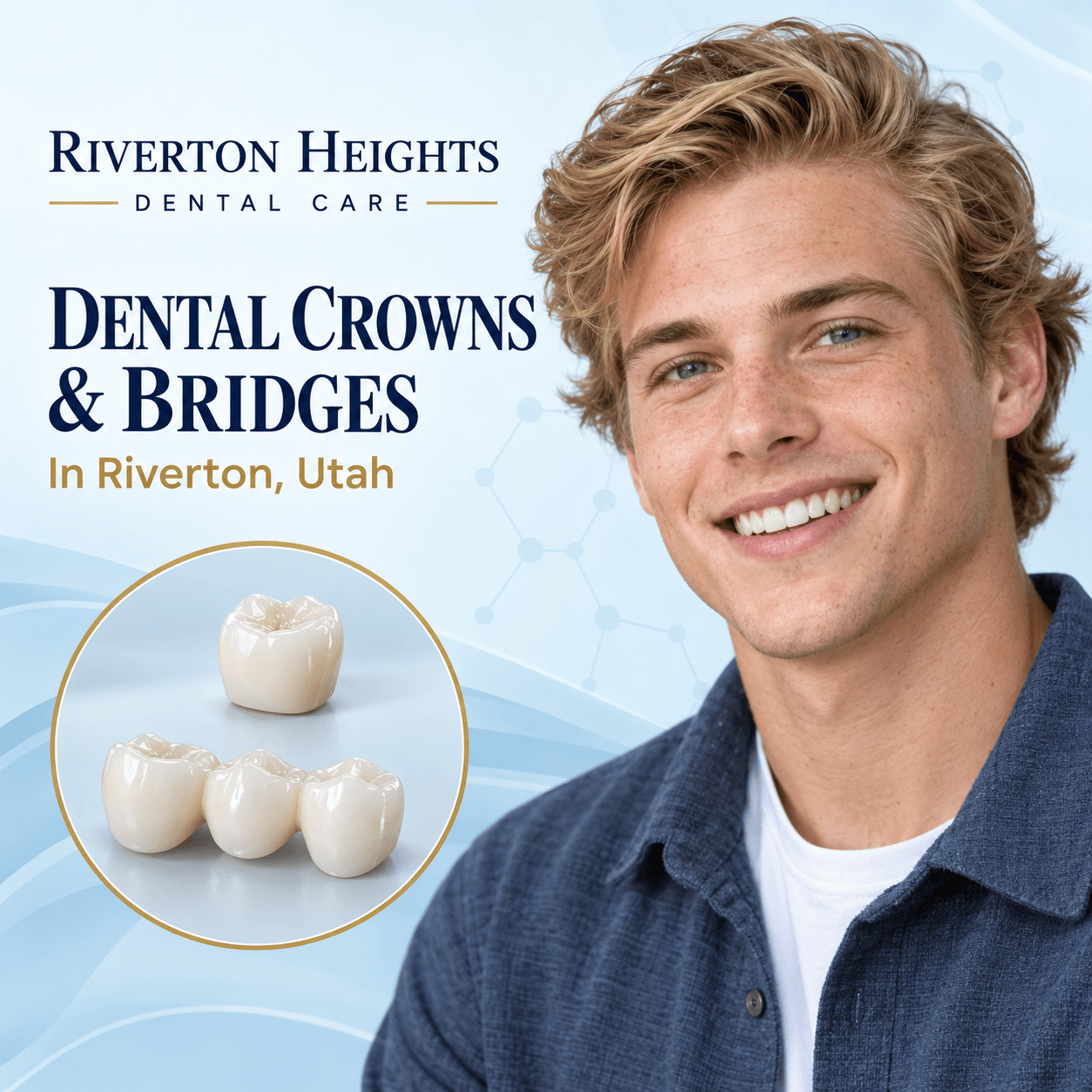
A dental crown is a tooth-shaped restoration that covers the visible portion of a damaged or weakened tooth. It can restore the tooth’s shape, protect the remaining structure, and provide a functional chewing surface.
A dental bridge is a fixed restoration used to replace one or more adjacent missing teeth. The replacement tooth or teeth are supported by crowns placed on neighboring teeth or, in some cases, by dental implants.
Crowns and bridges can be made from different dental materials and customized for the location of the restoration. The recommended material will depend on appearance, chewing forces, available tooth structure, and other clinical considerations.
What Can Crowns and Bridges Restore?
Crowns and bridges address different dental concerns, but both are designed to restore function and help protect the surrounding teeth. The appropriate treatment depends on whether the affected tooth can be preserved or needs to be replaced.
A crown or bridge in Riverton, Utah may be considered for:
- A cracked or fractured tooth
- A tooth weakened by a large filling
- Extensive decay that cannot be repaired with a smaller filling
- A tooth that has undergone root canal therapy
- A severely worn or damaged tooth
- A misshapen tooth requiring restorative coverage
- A single missing tooth
- Multiple adjacent missing teeth
- A dental implant that needs a final restoration
Not every damaged tooth can support a crown, and not every missing tooth should be replaced with a traditional bridge. Your dentist will evaluate the available support, gum health, bite, and surrounding structures before recommending treatment.
Are You a Candidate for a Crown or Bridge?
You may be a candidate for a dental crown if the affected tooth has enough healthy structure to support the restoration. A bridge may be appropriate when one or more teeth are missing and the proposed supporting teeth or implants are stable.
Your dentist will consider:
- The amount of healthy tooth structure remaining
- The size and location of decay or damage
- The health of the tooth’s nerve
- The condition of the gums and supporting bone
- The strength of the teeth beside a missing space
- The number and location of missing teeth
- Your bite and chewing forces
- Tooth-grinding or clenching habits
- Your appearance, maintenance, and budget priorities
A clinical examination and dental X-rays can help identify decay, fractures, infection, bone loss, and other concerns that may influence the treatment plan.
If a tooth has an active infection, additional care may be required before a crown is placed. If the teeth surrounding a gap are not suitable for supporting a bridge, an implant or removable replacement may be discussed.

Your Dental Crown and Bridge Evaluation in Riverton, Utah
Your consultation begins with a discussion of the problems you have noticed, such as pain when chewing, sensitivity, a broken tooth, or difficulty eating because of a missing tooth.
The dentist in Riverton, Utah will examine the affected area and explain which treatments may provide appropriate support. You will also have an opportunity to discuss the appearance, maintenance requirements, treatment sequence, and expected costs of each option.
Your Evaluation May Include:
- Reviewing your symptoms and dental history
- Examining damaged or missing teeth
- Taking dental X-rays when clinically appropriate
- Evaluating the tooth roots and supporting bone
- Checking the health of neighboring teeth and gums
- Reviewing your bite and available space
- Comparing crowns, bridges, implants, and other options
Tell your dentist if you grind your teeth, have difficulty cleaning certain areas, or have concerns about the appearance of the restoration. These details can affect the recommended material and design.
What to Expect During Treatment
The procedure varies according to the type of restoration, the number of teeth involved, and whether preliminary treatment is necessary.
Preparing the Tooth or Treatment Area
For a crown, the tooth is shaped to create space for the restoration. For a traditional bridge, the supporting teeth on each side of the gap are prepared for crowns. Local anesthesia may be used to keep you comfortable.
Capturing the Restoration Design
Digital scans or impressions are used to record the prepared teeth, bite, and surrounding structures. The restoration is then designed to fit the treatment area and coordinate with nearby teeth. A temporary crown or bridge may be placed while the final restoration is being created. Patients who qualify for dental crowns may be able to receive certain crowns without a separate laboratory fabrication period.
Placing and Adjusting the Restoration
The dentist checks the crown or bridge for fit, appearance, and contact with the opposing teeth. Once the necessary adjustments have been made, the restoration is secured in place and polished.
Your bite will be checked before you leave. Contact the office if the restoration feels too high or if you experience persistent or worsening discomfort after treatment.
Dental Crowns Compared With Dental Bridges
Crowns and bridges are fixed restorations, but they serve different purposes. A crown restores or protects an individual tooth, while a bridge fills a space created by one or more missing teeth.
Dental Crowns
- Cover and protect an existing tooth
- Restore shape and chewing function
- May support a tooth with a large filling
- Are often placed after root canal treatment
- Can be attached to a dental implant
Dental Bridges
- Replace one or more adjacent missing teeth
- Use neighboring teeth or implants for support
- Help restore chewing across an open space
- May reduce movement of teeth beside the gap
- Remain fixed in the mouth during daily use
The condition of the affected tooth, neighboring teeth, gums, bone, and bite will help determine which restoration is appropriate.
When Another Treatment May Be Appropriate
A crown or traditional bridge is not the only way to restore a damaged or missing tooth. Your dentist may discuss one or more related treatments after evaluating the extent of the problem.
Composite Dental Fillings
A composite dental filling may repair a smaller area of decay or damage when enough healthy tooth structure remains and full coverage is unnecessary.
Dental Crowns
A dental crown may allow an eligible tooth to be prepared and restored during one appointment using in-office digital technology.
Root Canal Therapy
Root canal therapy may be needed when the tissue inside a tooth becomes inflamed or infected. A crown may then be recommended to protect the treated tooth.
Dental Implants
A dental implant can support a replacement tooth without placing crowns on neighboring natural teeth. Implant treatment depends on bone health, medical considerations, and the location of the missing tooth.
Partial Dentures
Partial dentures provide a removable option for replacing several missing teeth. They may be considered when a fixed bridge or implant treatment is not preferred or appropriate.
Caring for Long-Term Maintenance
Some mild gum tenderness or temperature sensitivity may occur after a tooth has been prepared or a restoration has been placed. These symptoms should gradually improve.
To help protect your crown or bridge:
- Brush twice daily with fluoride toothpaste
- Clean between your teeth every day
- Use floss threaders or another recommended aid beneath a bridge
- Avoid chewing ice and other very hard objects
- Wear a nightguard if one is recommended
- Attend regular dental examinations and cleanings
The teeth and gums supporting a restoration still require daily care. Decay or gum disease can develop around a crown or beneath the supporting areas of a bridge.
When Should a Crown or Bridge Be Examined?
A crown or bridge should be evaluated if it:
- Feels loose or moves during chewing
- Develops a chipped or rough surface
- Causes persistent pressure or discomfort
- Traps food around or underneath it
- Produces an unpleasant taste or odor
- No longer feels balanced when you bite
Regular examinations allow the dentist to monitor the restoration, supporting teeth, gums, and bite.
How Much Do Dental Crowns and Bridges Cost?
The cost of treatment depends on the type of restoration, the number of teeth involved, the selected material, and the amount of preparation required. A bridge typically includes replacement teeth as well as the crowns or implants used for support.
Dental X-rays, temporary restorations, root canal therapy, extractions, or other preliminary procedures can also affect the total cost. Your treatment plan and expected fees will be reviewed before the restoration is placed.
Insurance benefits vary by plan and may include limitations, deductibles, waiting periods, or replacement schedules. Our team can help you review available benefits and discuss the practice’s financial options.
Schedule a Dental Crowns & Bridges Consultation in Riverton, Utah
A damaged or missing tooth can make everyday activities such as eating and speaking more difficult. Riverton Heights Dental Care provides custom dental crowns and bridges designed to restore function while complementing the appearance of your natural teeth.
Contact our Riverton dental office to request an evaluation and learn which restorative treatment may be appropriate for your smile.
Riverton Heights Dental Care
3693 W. 13400 S., Suite B
Riverton, Utah 84065
Phone
(801) 781-5784
Office Hours:
Monday–Thursday: 8:00 a.m.–5:00 p.m.
Friday–Sunday: Closed
Dental Crowns & Bridges FAQs
What is the difference between a dental crown and a bridge?
A crown covers and restores an existing tooth or dental implant. A bridge replaces one or more missing teeth and receives support from neighboring teeth or implants.
When would I need a dental crown?
A crown may be recommended when a tooth has extensive decay, a large filling, a fracture, significant wear, or reduced strength following root canal therapy. The tooth must be evaluated to determine whether it can support the restoration.
When would I need a dental bridge?
A bridge may be considered when one or more adjacent teeth are missing and there are suitable teeth or implants available for support. Your gum health, bone support, bite, and ability to maintain the restoration will also be considered.
How many appointments are needed for a crown or bridge?
Traditional crowns and bridges often require a preparation appointment followed by a placement appointment. Some eligible crowns may be completed in one visit, but bridges and more complex cases generally require additional fabrication time.
Will my crown or bridge look natural?
The restoration can be shaped and shaded to coordinate with the surrounding teeth. Its final appearance depends on the selected material, the tooth’s location, the available space, and other clinical factors.
How long do dental crowns and bridges last?
Their longevity varies according to the restoration’s design, supporting tooth health, bite forces, oral hygiene, diet, and habits such as grinding or chewing hard objects. Regular dental visits help identify wear or other problems that may affect the restoration.
Is getting a crown or bridge painful?
Local anesthesia may be used during tooth preparation to help keep you comfortable. Temporary sensitivity or gum tenderness can occur afterward, but persistent or severe pain should be evaluated.
How should I care for a crown or bridge?
Brush twice daily, clean between your teeth, and attend routine dental appointments. Bridges require careful cleaning beneath the replacement tooth, and your dental team can recommend an appropriate floss threader, interdental brush, or water flosser.